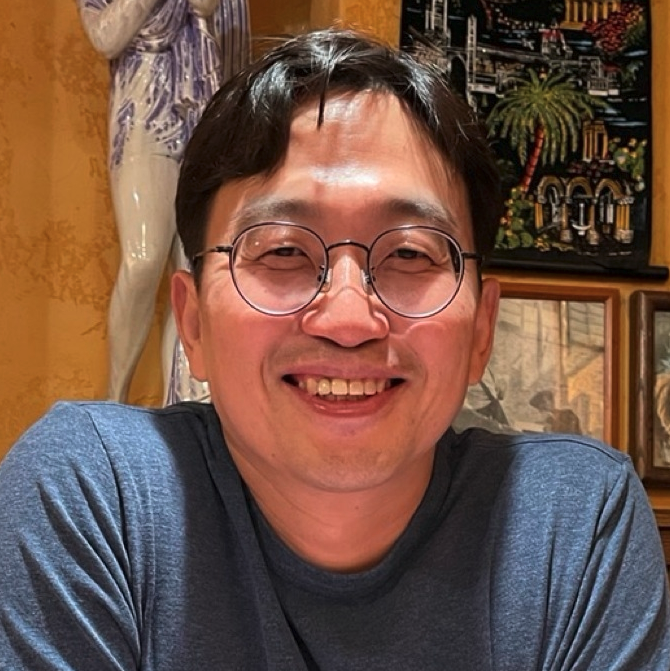
[KOBRA Conference 2026 AI-Biotech Special Talk] From Silicon Valley AI to Multi-Omics Medicine - Versatile Smart Assays Transform Cancer Diagnostics and Prognosis Prediction Through Cross-Domain Innovation
Abstract
This presentation traces an unconventional journey from Silicon Valley’s AI frontlines to the cutting edge of cancer diagnostics, demonstrating how cross-domain innovation can revolutionize biomedical applications. Drawing from a unique background spanning Stanford PhD research in Convex Optimization under Prof. Stephen Boyd, 12 years optimizing semiconductor manufacturing at Samsung, building $200M+ revenue AI systems at Amazon, and now pioneering AI-powered biotech as Co-Founder & CTO of Erudio Bio & Co-Founder & CEO of Erudio Bio Korea, this talk explores how Mathematical Principles, Optimization Theory, and Machine Learning (ML) converge to address one of medicine’s greatest challenges. Rather than simply applying existing AI tools to biological data, we’ll examine how the fundamental patterns discovered across domains—from semiconductor physics to recommendation algorithms—provide unexpected insights into the complex, multi-dimensional nature of cancer detection and prognosis. This cross-pollination of ideas exemplifies the “connector’s mindset” essential for breakthrough innovation in an increasingly interdisciplinary scientific landscape.
At the heart of this transformation lies Erudio Bio’s Versatile Smart Assay (VSA) platform, which leverages patented dynamic force spectroscopy to detect cancer biomarkers with unprecedented sensitivity and specificity. We’ll explore how this technology naturally extends into multi-omics integration, combining genomic, proteomic, and metabolomic data streams through advanced AI algorithms to create comprehensive diagnostic and prognostic models. Through concrete case studies from our Gates Foundation-supported bioTCAD drug discovery platform and ongoing clinical collaborations with institutions like Seoul National University Bundang Hospital (SNUBH) and Keimyung University Dongsan Hospital, we’ll demonstrate how VSA technology transcends traditional single-biomarker approaches to enable true precision medicine. The presentation will detail our algorithmic innovations for handling high-dimensional, heterogeneous biological data while maintaining clinical interpretability—a critical challenge where mathematical rigor meets practical healthcare needs.
Looking beyond current capabilities, we’ll envision the future of AI-native diagnostic platforms that don’t merely detect disease but predict its trajectory, treatment response, and optimal intervention strategies. This vision extends our earlier exploration of how AI represents “something entirely new” rather than simple automation—in biomedical applications, AI can actively discover novel biomarker combinations and disease mechanisms that human analysis alone might never uncover. We’ll discuss how Korea’s unique strengths in advanced manufacturing, AI development, and biomedical research position it to lead this transformation, while addressing the paradigm shifts required for seamless human-AI collaboration in clinical settings. The session concludes with actionable insights for biotech researchers and entrepreneurs – how to bridge technological innovation with clinical impact, and why the future of precision medicine will belong to those who master the synthesis of cross-domain expertise with AI amplification rather than those who pursue either technology or biology in isolation.